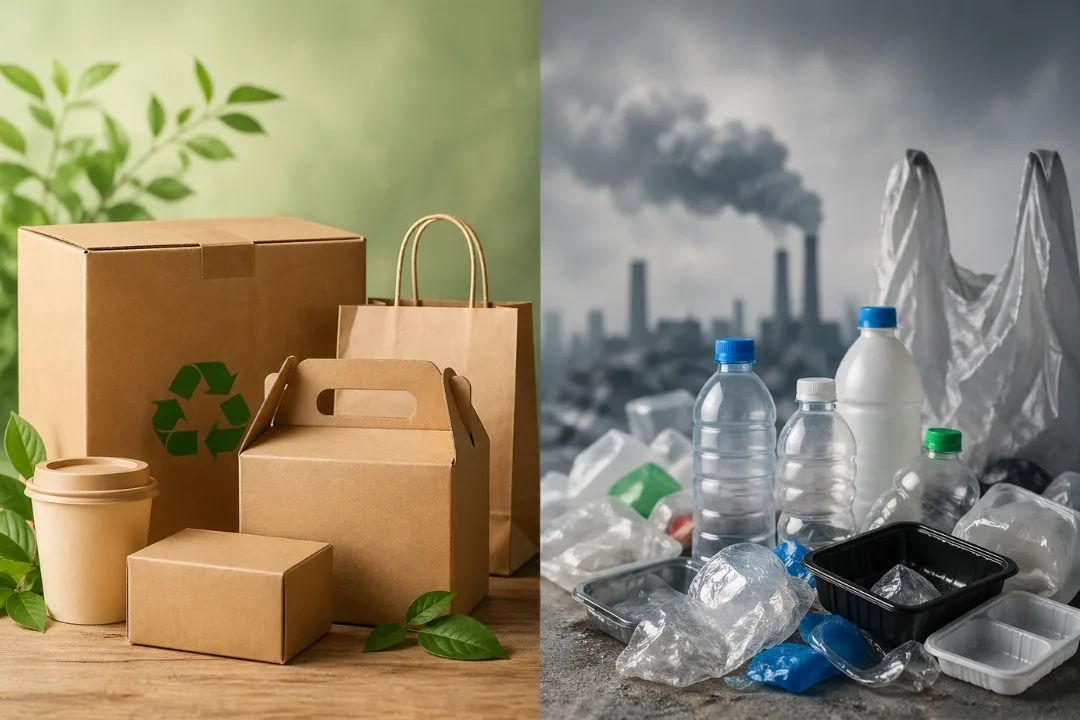
The paper packaging vs plastic packaging conversation is one that Indian brands can no longer push to the next quarter.
Not because sustainability became fashionable. Because the cost of staying with plastic in 2026 now has actual penalty numbers attached to it.
India’s Plastic Waste Management Rules have been updated repeatedly since 2016 – with amendments in 2018, 2021, 2022, and now 2025-2026. The 2026 changes are the most operationally consequential yet, moving from banning specific items to requiring comprehensive lifecycle management of all packaging.
Brand owners who have not started adjusting are already behind.
Paper Packaging vs Plastic Packaging: Where the Indian Market Stands Today
The market data is not ambiguous.
India’s paper packaging market was valued at USD 19.42 billion in 2025 and is projected to reach USD 28.55 billion by 2034. That growth is coming from e-commerce, FMCG, food delivery, and pharma – all moving in the same direction at once.
Plastic still holds volume. Plastic packaging held roughly 45% of the overall Indian packaging market in FY 2023. But the compliance burden attached to it has changed the per-unit economics for many businesses.
Corrugated packaging alone accounted for 48.24% of India’s paper and paperboard packaging market in 2025. Every e-commerce order needs a box. Corrugated paper is already the default – and that demand is only accelerating.
What India’s 2026 Plastic Rules Actually Changed
Four things changed. All four hit operations directly.
- EPR registration is live: Brand owners, importers, and e-commerce entities must register on the CPCB portal, declare packaging quantities, and meet recycling or composting targets from 1 April 2026.
- QR codes on all plastic packaging: All plastic packaging must carry traceable QR codes, barcodes, or unique identifiers from January 2025 onwards. That is a supply chain change, not just a label tweak.
- 40% recycled content in rigid plastic: Rigid plastic packaging must contain 40% recycled content for FY 2026-27. Food-grade recycled resin costs more than virgin resin, so compliant plastic is now more expensive per unit.
- Penalties with teeth: Non-compliance penalties range from INR 10,000 to INR 15 lakh per violation, with the potential for daily penalties, permit suspension, and confiscation.
Paper packaging avoids most of this. The recycled content target does not apply to paper and board packaging. No QR traceability requirement. The composting EPR route is simpler to document than the plastic recycling chain.
For a brand managing multiple SKUs across retail and e-commerce, that simplification matters.
Why Brands Are Actually Switching – Beyond Just Compliance
Compliance lit the fire. But three other things are keeping it burning.
Consumer preference has moved faster than expected
Several MNCs – including Coca-Cola, PepsiCo, and Parle Agro – announced a move to 100% recyclable packaging by 2025 for their India products. When those brands make public commitments, retail buyers start asking the same of smaller suppliers. Paper-based packaging among urban Indian consumers is now a shelf consideration, not just a sentiment.
E-commerce economics favor paper
India’s e-commerce market is projected to reach USD 651.10 billion by 2034, growing at a CAGR of 19.63% from 2026. Quick-commerce platforms running micro-fulfillment centers need right-sized corrugated boxes – printable, stackable, and fast to process. Plastic mailers do not fit that model. Paper does.
Industry investment is flowing into paper capacity, not plastic
JK Paper merged Horizon Packs, Securipax Packaging, and JKPL Utility Packaging in December 2024 and acquired Radhesham Wellpack to expand corrugated capacity.
ITC PSPD launched its Filo series of sustainable paperboards to replace single-use plastics in food and beverage packaging – gaining traction both in India and internationally.
When major suppliers expand paper capacity and not plastic, it affects how converters price and prioritize orders downstream.
Where Paper Packaging Works Best for Indian Brands
Paper packaging performs well across several categories that together cover a large chunk of India’s retail market:
- Dry food and FMCG – Folding cartons for cereals, snacks, and personal care are a clean switch with no product protection trade-off
- E-commerce and quick-commerce – Corrugated boxes and mailers are already standard; the shift now is toward branded print and right-sizing to cut waste
- Pharmaceuticals – Folding cartons for medicine boxes are a long-established use case; secondary packaging is moving to recyclable paperboard
- Personal care and cosmetics – India’s personal care sector produced 186.6 billion packaging pieces in 2024, with brand owners already favoring matte-finish cartons with soft-touch lacquers and foil stamping
Where paper still has limits
Uncoated paper does not handle moisture or grease as well as plastic. That matters for wet foods, chilled products, and liquids.
The gap is narrowing. Barrier-coated paper grades now provide grease resistance previously achieved only with plastic laminates. But brands in those categories need to assess coated grades specifically – not just swap materials. For a detailed overview of how India’s paper industry is investing in barrier-coated grades, the IBEF paper packaging report is a useful reference.
The Machine Side of This Switch
Switching materials is only half the job.
If you are a packaging converter or a brand running in-house production, your equipment needs to handle folding cartons and corrugated formats at volume – without excessive waste or downtime.
The core machines for paper carton production are:
- Automatic folder gluers – for sealing and forming cartons at speed
- Die-cutting machines – for clean, precise cutting of paperboard blanks
- Flute laminators – for corrugated board production
Running mismatched or ageing equipment when orders shift to paper means higher waste rates and quality issues at speed. Companies like Robus India, based in Greater Noida, manufacture folder gluers, die-cutting machines, and lamination equipment specifically for the folding carton and corrugated segments. Getting the machine side right is what lets converters actually scale when demand shifts.
For India’s packaging regulatory framework, the CPCB plastic waste management guidelines and BIS packaging standards are the two primary references worth bookmarking.
Quick Comparison: Paper vs Plastic for Indian Brand Managers
| Factor | Paper | Plastic |
| EPR compliance | Simpler – no recycled content mandate | Complex – registration, QR codes, 40% recycled content |
| Cost per unit | Slightly higher upfront | Lower per unit, but compliance costs are rising |
| Moisture resistance | Lower (unless barrier-coated) | High |
| Printability for branding | Excellent | Good, fewer texture options |
| Consumer perception | Positive and growing | Declining in urban markets |
| E-commerce suitability | High corrugated is the standard | Moderate |
| Biodegradability | Decomposes naturally | Takes hundreds of years |
What to Do Right Now If You Are Still Running on Plastic
Start with the steps that cost nothing but time:
- Audit your packaging portfolio – Identify which SKUs use single-use plastic covered by the 2022 SUP ban or the 2026 EPR rules.
- Register on the CPCB portal – If you have not already – the April 2026 EPR deadline is active.
- Start with secondary packaging – Corrugated outer boxes are the lowest-risk entry point for paper, with no product protection trade-off.
- Ask your converter about barrier-coated grades – If moisture or grease is your concern, food-grade paper alternatives now exist for most applications.
- Review your machinery – If you are a converter, check whether your folder gluer and die-cutting equipment can handle the volume increase that paper demand will bring.