Food packaging boxes in India have quietly become one of the more complex decisions a food business has to make. Pick the wrong board, run it through the wrong machine, or miss a line in the FSSAI rulebook – and you’re looking at either a failed inspection, damaged product, or a box that falls apart somewhere between the factory floor and a customer’s hands.
India’s food packaging market was valued at around USD 14.2 billion in 2025 and is on track to cross USD 25 billion by 2034. That kind of growth means more competition, tighter quality expectations, and – importantly – stricter regulatory scrutiny. Whether you run a snack brand, a bakery, or a mid-sized packaging converter supplying food companies, the fundamentals here are worth getting right.
Food Packaging Boxes in India: Getting the Material Right First
The material you choose isn’t just a cost decision. It directly affects how long your product stays fresh, how it looks on a retail shelf, and whether it passes a food safety audit.
Folding Paperboard – SBS, Duplex, and Kraft
For retail food cartons – think biscuit boxes, cereal packs, dry snack sleeves, spice cartons – folding paperboard is the standard. SBS (solid bleached sulphate) board is the cleanest option when the inner surface touches food directly. Duplex board works well when you need decent printability on the outside without the premium cost of SBS. Kraft board has found its own audience with organic and natural food brands because it signals something unprocessed and earthy – which a lot of consumers actually respond to these days.
Corrugated Board – 3-ply, 5-ply, and Beyond
Corrugated is the workhorse of food transit packaging. A 3-ply box handles lighter, dry goods. 5-ply is better suited for frozen foods, heavy packaged products, or anything travelling through India’s varied logistics conditions. For very heavy industrial food shipments, some manufacturers go up to 7-ply.
One thing worth noting: paper and paperboard captured close to 39% of India’s food and beverage packaging market in 2025, and that share is growing as brands shift away from single-use plastics and respond to recycled-content regulations.
Coated and Laminated Boards
Some food products need more than plain board. Greasy snacks, frozen items, and bakery products with high moisture content need a barrier layer – usually PE coating or a BOPP laminate film applied over the board. This stops oil migration and moisture damage, which would otherwise ruin both the product and the box.
A quick but important note here: whatever coating or film you use on packaging that touches food, it needs to be food-grade. This isn’t optional.
The Machines That Actually Make the Boxes
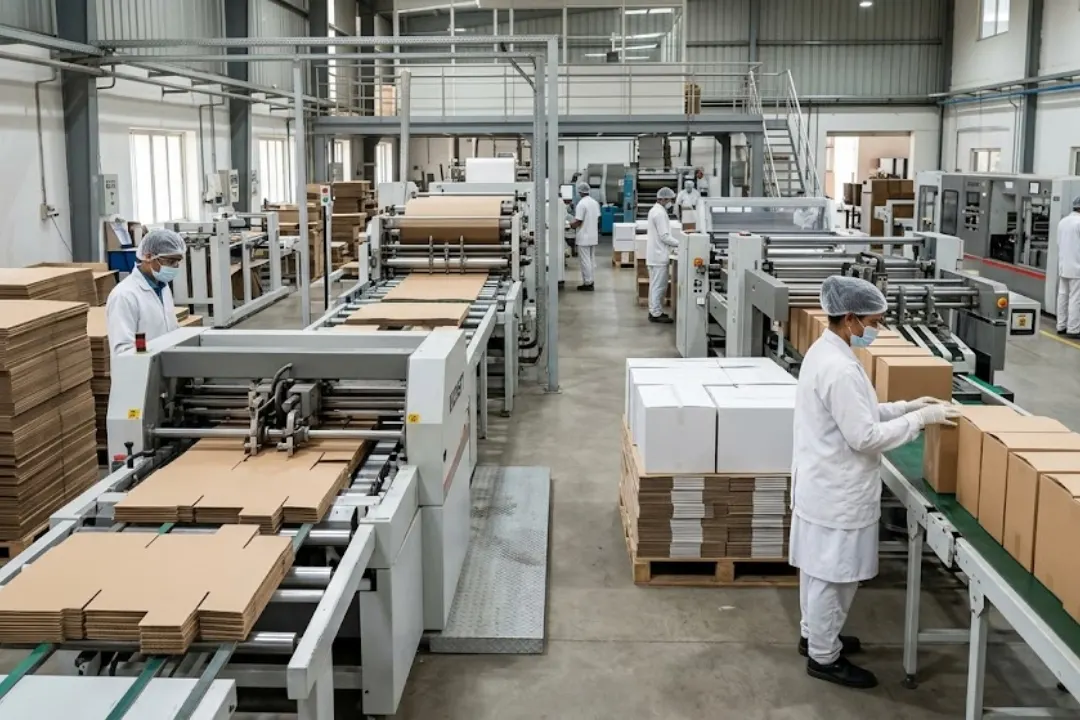
Getting the material sourced is the first half. The second half is having a production setup that can convert flat sheets into finished, FSSAI-compliant food cartons at volume. Here’s how a typical production line looks:
Die Cutter
This is where sheets get cut and creased into the exact shape your box will take. Precision at this stage matters more than people realise – poor crease lines lead to corners that tear open on retail shelves, which is a real problem for food brands trying to hold a clean shelf presentation.
Folder Gluer
After cutting, blanks are folded and glued into finished boxes. For food packaging in particular, glue placement accuracy is non-negotiable. A misaligned glue joint on a food carton isn’t just an aesthetic problem – it’s a hygiene concern. High-speed servo-controlled folder gluers handle this well; older mechanical machines often can’t maintain the consistency needed at scale.
Flute Laminator
Used when you’re making corrugated food boxes that need a printed outer surface. The flute laminator bonds a pre-printed sheet onto the corrugated board, giving you the structural strength of corrugated with the clean look of a printed carton. The result is what you typically see on retail-ready corrugated trays in modern trade.
Film Lamination Machine
For the coated finish we talked about earlier – BOPP gloss, matte, or soft-touch laminate – a film lamination machine applies the film over the printed surface before the sheet goes to die cutting. Premium food brands use this a lot because it also strengthens the box against handling damage.
Hot Foil Stamper
Not strictly necessary for every food box, but common in the premium category. Chocolates, speciality teas, dry fruit gift boxes – anything positioned at the higher end of the market. Foil stamping gives a box that tactile, premium feel that’s hard to replicate with print alone.
Robus India, a carton packaging machine manufacturer based in Greater Noida, offers the full line of these machines – from die cutters to folder gluers, flute laminators to hot foil stampers – with installation support and after-sales service across India. For a food packaging operation that needs to scale, having one supplier cover the full machine portfolio is genuinely convenient.
FSSAI Compliance: What the Rules Actually Say
This is where a lot of food businesses get caught off guard, especially smaller ones. FSSAI’s rules on packaging aren’t just about what’s printed on the label – they cover the packaging material itself.
The governing document is the Food Safety and Standards (Packaging) Regulations, 2018, which replaced the earlier 2011 regulations. In April 2025, FSSAI also reclassified food-grade packaging materials from “non-critical” to “critical” in its inspection checklists – meaning packaging compliance now gets audited with the same weight as hygiene and food handling practices. That’s a significant shift.
What the regulations require for food packaging boxes:
- Any material in direct contact with food must be food-grade and conform to the relevant BIS (Bureau of Indian Standards) specification – for example, IS 6622 applies to greaseproof paper used in food-contact applications.
- You need a certificate of conformity from a NABL-accredited laboratory for any packaging material touching food directly.
- Printing inks on the outer surface must not come in direct contact with food – there must be a barrier layer between the printed surface and the food.
- Migration of harmful substances from packaging into food must stay within prescribed limits.
- Paper and board used for primary packaging must be uniform in thickness and free from physical defects like pinholes, cuts, or grease spots.
On labelling, the boxes must carry:
- Product name, ingredient list, and net quantity
- Manufacturing date and best-before or use-by date
- Batch or lot number
- FSSAI licence number
- Manufacturer’s name and address
- Nutritional information (where applicable under the product category)
Packages with a surface area of 100 sq cm or below get some exemptions on labelling elements, but multi-unit packaging must still carry the complete information.
One more thing worth flagging: in February 2026, FSSAI issued a draft amendment proposing formal definitions for “food contact material” and related terms. This is a signal that the regulatory framework is tightening further – food businesses and packaging converters should keep an eye on how this draft gets finalised.
Putting It Together
For anyone setting up or scaling a food packaging operation in India, the decision chain looks roughly like this: identify the food product type and its packaging demands → choose the right board grade and coating → set up or source the right machine line → verify material compliance with NABL lab certificates → check labelling against current FSSAI requirements.
None of these steps is particularly complicated on its own. The trouble usually comes when one of them gets skipped under time pressure or cost pressure – and that tends to surface at the worst possible moment: during a regulatory inspection or after a product return.
Get the material and machine choices right from the start, and the compliance part becomes far more manageable.