Carton Strapping machine – three words that don’t get nearly enough attention in packaging discussions, yet this single piece of equipment can make or break the efficiency of your entire post-press line. If you run a folding carton or corrugated packaging operation, you already know that die cutting is only half the story. What happens right after the cut is where production either moves smoothly or grinds to a halt.
This blog covers what a carton Strapping machine actually is, how it fits into the die-cutting workflow, the types available, and why getting this step right matters for output quality, labour costs, and overall line speed.
Carton Strapping Machine: The Step Most Converters Underestimate
To understand why Strapping matters, you first need to picture what a sheet looks like right after it exits a die cutter.
The press has done its job – cuts and creases are in place. But the sheet is still one connected piece. The finished carton blanks are surrounded by waste material: the outer edge trim, inner cut-outs (like hand holes or window openings), and the gaps between individual blanks on the sheet. None of that excess board removes itself.
That’s exactly what a carton Strapping machine is built to do.
It separates the usable carton blanks from all the surrounding waste material in a controlled, repeatable way – either mechanically, automatically, or through a combination of both – so the blanks can move cleanly to the next stage: folding, gluing, or packing.
Without this step being handled properly, you end up with:
- Torn or damaged blanks caused by manual handling
- Inconsistent waste removal that slows downstream operations
- Jams and stoppages on your folder-gluer
- Higher labour costs from manual Strapping teams
How the Die-Cutting Process Creates the Need for Strapping
When a die-cutting press processes a sheet of paperboard or corrugated board, the steel rule die cuts through the material to define the exact shape of the carton. It also scores fold lines and may perforate tabs or tear strips.
But the sheet stays in one piece after the cut. The cuts are clean, but the waste and the blanks are still connected – held together by small uncut sections called “nicks” that keep the sheet from falling apart prematurely inside the press.
Once the sheet exits the delivery section of the die cutter, those nicks need to be broken and the waste needs to be cleared before the blank can be used. This is where Strapping comes in as a distinct production stage.
In post-press packaging operations, Strapping is defined as the mechanical or manual removal of waste sections from a die-cut sheet, leaving only the finished blanks. It sits between die cutting and blanking/collecting, and it directly determines how clean and ready those blanks are for the next machine.
Types of Carton Strapping Machines
Not every packaging operation requires the same Strapping setup. The right choice depends on your run volumes, board types, carton complexity, and how automated your overall line is.
1. Manual Strapping Tables
The simplest approach. Operators stack die-cut sheets and use hand tools or by-hand pressure to push out waste sections. This works for short runs and complex shapes, but it’s slow, inconsistent, and physically demanding. It’s also the biggest bottleneck in high-volume production.
2. Semi-Automatic Strapping Machines
These use a combination of mechanical tooling and operator input. The machine handles the primary Strapping motion while an operator feeds sheets and monitors quality. A good middle-ground option for medium-volume converters who haven’t yet justified a fully automatic line.
3. Automatic Inline Strapping Machines
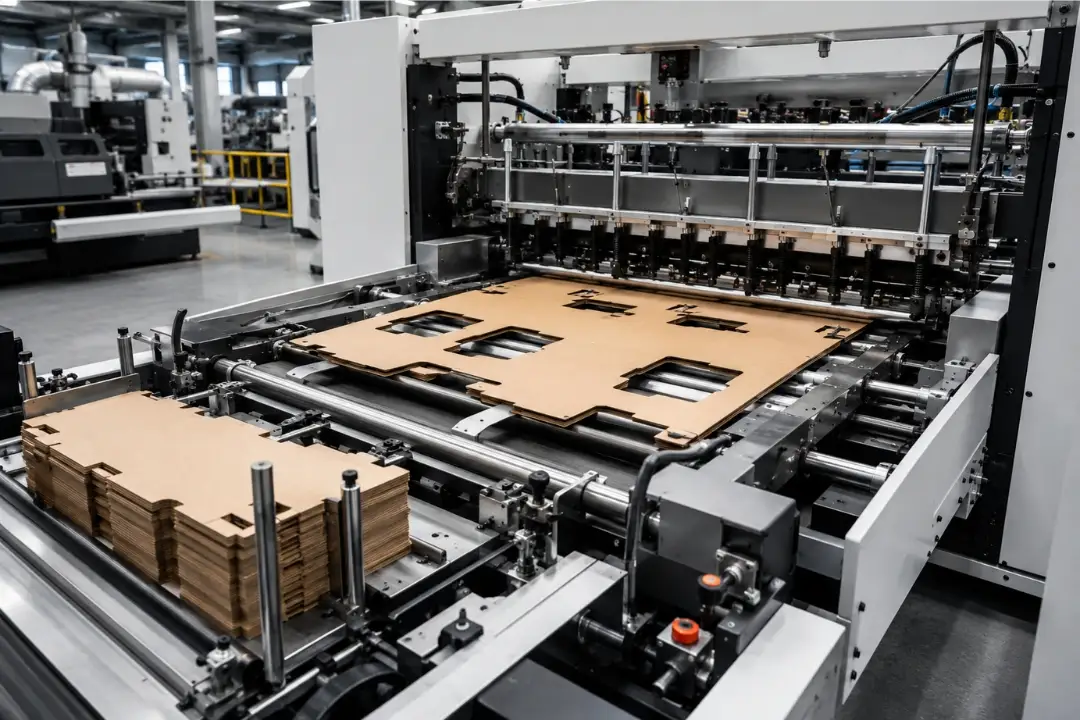
These are installed directly after the die cutter and handle waste removal without operator intervention. The sheet passes through Strapping pins, rubber ejectors, or rotary tools that push out waste sections in one continuous motion. These machines operate at speeds that match the output of the die cutter, keeping the line moving without creating a Strapping bottleneck.
4. Automatic Strapping with Blanking Combined
Some machines combine Strapping and blanking into a single unit. After the waste is removed, the individual blanks are separated and stacked in neat piles. This integrated approach is common on high-speed folding carton lines where floor space and cycle time are tight.
What Strapping Tools Actually Look Like Inside the Machine
Understanding the tooling helps you appreciate why setup time and tool quality matter so much.
A Strapping tool is essentially a board – similar in layout to the die board – fitted with:
- Male pins or punches positioned over waste areas that push the unwanted sections downward
- Female boards underneath with corresponding openings that receive the waste as it’s ejected
- Rubber ejectors on the die itself that help release the sheet cleanly after each press cycle
The male and female boards have to be precisely matched to the die layout. Any misalignment leads to torn blanks, incomplete waste removal, or tool damage. This is why proper makeready – setting up your Strapping tools correctly before the run – is just as important as the machine itself.
According to folding carton converting best practices, the pre-makeready team should have all Strapping and blanking tooling ready before the current press job finishes. Waiting until the press is idle to begin tooling setup wastes press time – one of the most expensive resources in a converting plant.
Why Strapping Quality Directly Affects Folder-Gluer Performance
Here’s something that doesn’t get discussed enough: the condition of your blanks coming off the Strapping stage has a direct impact on how your folder-gluer runs.
If waste removal is incomplete, torn, or inconsistent, you’ll see:
- Misfeeds on the folder-gluer infeed section caused by blanks with attached waste flaps
- Glue contamination from waste pieces entering the gluing section
- Jamming and downtime when irregular blanks interrupt the folding sequence
- Increased operator intervention to clear blanks that aren’t folding cleanly
A well-configured carton Strapping machine delivers blanks that are clean, consistent, and dimensionally correct. That’s what a high-speed folder-gluer needs to run at its rated speed without interruption.
Robus India’s automatic die cutters – including the Duo Press and Trio Press series – are engineered with downstream compatibility in mind. Whether you’re running an inline Strapping station or a standalone automatic Strapping machine after the press, the delivery section is designed to feed cleanly into the next stage without sheet distortion or misfeed issues.
Common Strapping Problems and What Causes Them
Even with the right equipment, Strapping problems can creep in. Here are the most frequent ones and their causes:
Waste not ejecting cleanly: Usually caused by worn ejector rubber on the die, under-cutting (nicks that are too large), or misaligned Strapping pins. Check your ejector rubber condition regularly – it wears faster than most operators expect.
Blanks tearing during Strapping: Often a sign that the male pins are positioned too aggressively, or that the board is soft and absorbing too much force. Adjusting pin height and spring tension usually resolves this.
Incomplete waste removal on inner cut-outs: Inner waste sections (like hand holes or window cutouts) are harder to eject than outer waste. Make sure the female board has clean, sharp-edged openings, and that inner Strapping pins are specifically positioned for each internal cut area.
Inconsistent performance across the run: This points to Strapping tool wear, sheet pile variation (inconsistent moisture content in the board), or speed settings that are too aggressive for the substrate. Monitoring Strapping tool condition across long runs and replacing worn components proactively keeps your reject rate low.
Strapping vs Blanking: Understanding the Difference
These two terms often get used interchangeably, but they refer to different stages.
Strapping removes the waste material from around and between the carton blanks on the sheet. The blanks remain on the sheet (or partially separated) after Strapping.
Blanking (also called break-out or delivery blanking) is the next step – it fully separates the individual carton blanks from each other and stacks them into neat piles ready for the folder-gluer.
On some machines, both steps happen in one pass. On others, they’re handled by separate stations. Either way, Strapping always comes first, and the quality of blanking depends on how cleanly Strapping was done.
How Automatic Strapping Saves Time and Reduces Waste Costs
The economics of investing in automatic Strapping are fairly straightforward once you look at the numbers across a full production shift.
Consider a manual Strapping team of three operators working at a rate of 800–1,200 sheets per hour. A well-configured automatic Strapping machine handles 5,000–8,000 sheets per hour or more, depending on the board and job complexity, with one operator overseeing the line rather than performing repetitive Strapping work.
The benefits stack up in multiple ways:
- Labour cost reduction from replacing manual Strapping positions
- Faster turnaround between die cutting and gluing stages
- Lower blank damage rate because the machine’s strapping is consistent, not fatigued
- Better traceability on reject rates – you can measure and monitor what a machine does; manual Strapping is much harder to standardize
- Less physical strain on your workforce, reducing absenteeism and injury risks from repetitive manual tasks
For converters running multi-shift operations on folding carton or pharmaceutical packaging, the payback period on automatic Strapping equipment is typically well within two years.
Which Industries Use Carton Strapping Machines Most?
Strapping machines are used across virtually every sector that produces folding carton or corrugated packaging, but the need is most acute in:
- Pharmaceutical packaging – where clean, consistent blanks are required for compliance and cartoning machine compatibility
- Food and beverage packaging – high-volume runs demand fast, reliable Strapping to keep pace with filling lines
- Cosmetics and personal care – complex carton shapes with inner cut-outs require precise Strapping tooling
- E-commerce packaging – rapid SKU changes mean frequent job changeovers, placing pressure on Strapping setup speed
- Corrugated carton manufacturing – larger blanks with heavier board need robust, high-force Strapping setups
What to Look for When Choosing a Strapping Setup
If you’re evaluating Strapping solutions for your packaging line, here are the questions worth asking:
- Does the Strapping station run at a speed that matches your die cutter’s output, or will it create a bottleneck?
- How long does Makeready take when changing between jobs? Faster changeover means more uptime.
- Can the tooling handle your range of board weights (GSM) and sheet sizes?
- Is the machine designed for inline integration with your existing press, or does it operate as a standalone station?
- What is the parts availability and service support like for your location?
Robus India’s packaging line solutions – from automatic die cutters to downstream handling equipment – are built with production continuity in mind. The team works with converters to assess their specific job mix, board types, and output targets before recommending a configuration, rather than pushing a one-size-fits-all setup.
The Bottom Line
A carton Strapping machine isn’t a peripheral piece of equipment – it’s a load-bearing step in your packaging workflow. Every blank that goes into your folder-gluer is passed through, Strapping first. If that step is slow, inconsistent, or damaging to the board, the effects carry forward through your entire production chain.
Getting Strapping right means your die cutter output actually reaches its potential, your folder-gluer runs at speed, and your finished carton quality holds up from the first sheet to the last.
Whether you’re running corrugated cases, pharmaceutical folding cartons, or retail-ready consumer packaging, the right Strapping setup – matched to your equipment, your board, and your volumes – is worth the investment in evaluation and setup time.
To learn more about how Robus India’s die cutting and post-press solutions can work together for your operation, get in touch with the team for a consultation.