Automatic Packing Machine adoption in India has picked up pace over the last five years, and not just in large factories. Mid-size food units, carton manufacturers, and pharma companies are all moving in this direction. The reason is fairly straightforward, labour availability is getting trickier, order volumes are going up, and buyers want consistent packaging across every batch.
India’s packaging industry is currently valued at over Rs 3.7 lakh crore and growing at roughly 14% per year. That growth puts pressure on manufacturers to pack more, faster, without proportionally increasing their workforce.
How an automatic packing machine actually works
The basic job of any packing machine is the same, take a product, put it in packaging, and seal it. What changes is how much of that cycle runs without someone physically doing each step.
In a fully automatic setup, the process runs roughly like this:
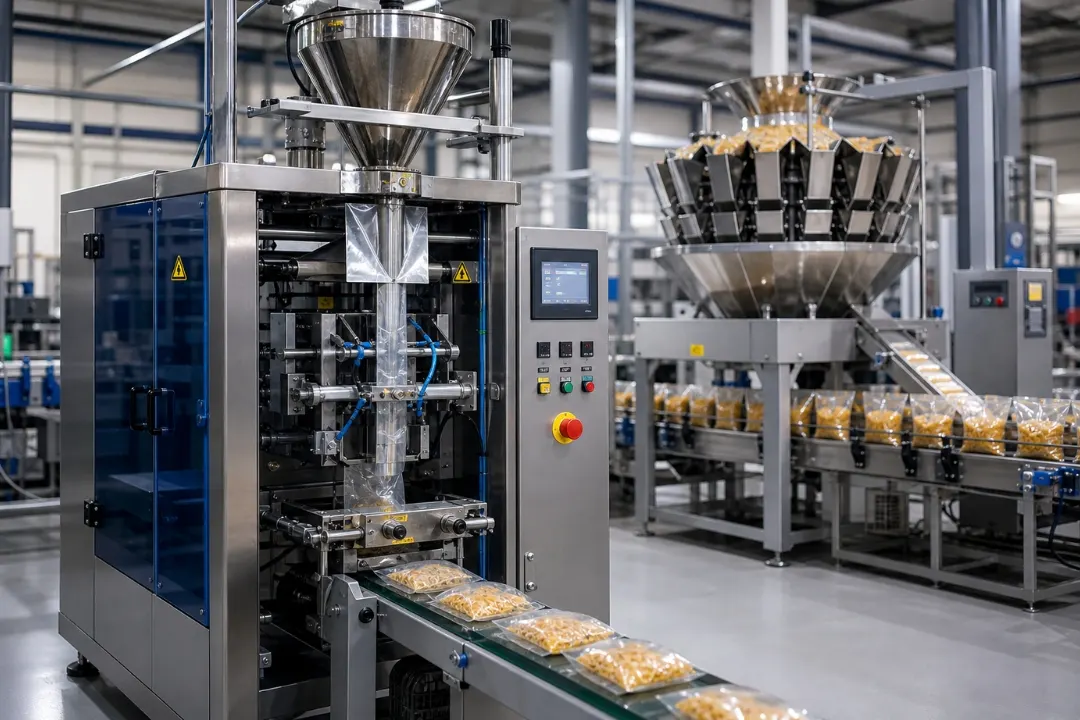
The product comes in through a hopper or conveyor feed. The machine measures the right quantity, using an auger for powders, a cup filler for granules, or a multihead weigher for mixed or irregular items. The packaging film or carton blank is positioned, formed around the product, then sealed using heat or adhesive. A batch coder prints the MFD, expiry, and MRP inline. Finished packs go out on a discharge conveyor.
A PLC (Programmable Logic Controller) manages all of this simultaneously. Sensors check for empty pouches, overfills, or seal failures and can stop the line automatically if something is wrong. That is why packing accuracy on these machines tends to be much better than what a manual line achieves, especially over long production runs.
Types of machines and what they handle
Not every product needs the same machine. Here are the main types used across Indian industries:
VFFS machines (Vertical Form Fill Seal) are the most common in food and FMCG. Film rolls feed from a reel, form into pouches vertically, fill from above, and seal. Speeds range from 40 to 120 pouches per minute depending on product and pouch size. Spices, flour, snacks, coffee, and tea are typical applications.
HFFS machines (Horizontal Form Fill Seal) work better for products that cannot be dropped vertically, biscuits, soap bars, medical devices. The product moves horizontally through the wrapping zone.
Folder gluer machines are built for carton packaging. A flat printed carton blank goes in, gets folded at precise crease lines, glued, and stacked. These run at very high speeds, production lines in carton units can fold and glue hundreds of cartons per minute.
Automatic die cutters sit before the folder gluer in the workflow. They cut carton shapes from printed sheets with consistent pressure and precision. Without accurate die cutting, the folding stage will produce misaligned boxes.
Flute laminators are used to laminate corrugated layers onto carton boards before cutting. They are standard in units, making boxes for the e-commerce, electronics, or pharma sectors where board strength matters.
Rotary pouch packing machines handle pre-formed pouches, common for liquids, pastes, and thick granules. The dairy, sauce, and personal care sectors use these regularly.
Which industries in India use these machines the most
Food processing
This is the biggest segment by volume. A spice company packing 300 SKUs a day cannot run that on a manual line without employing a large workforce and still getting inconsistent fill weights. A VFFS machine with a multihead weigher handles multiple pack sizes with the same equipment, and fill accuracy is repeatable batch after batch.
FSSAI also requires proper date coding and tamper-evident packaging. Automatic machines handle both inline, which removes a separate manual step.
Pharmaceuticals
Pharma packing requirements in India are among the tightest, whether a unit is targeting domestic CDSCO compliance or export to regulated markets. Blister packaging, strip packing, and carton erecting lines all need to run with minimal human contact on the product, consistent dose counts, and integration with serialisation systems for track and trace.
Any pharma facility aiming for WHO-GMP or US FDA registration needs packing automation. There is no way around it.
FMCG and personal care
Detergent sachets, shampoo pouches, and household product packaging run on multi-track machines that produce several pouches simultaneously across parallel lanes. One line can replace what would otherwise need 15 to 20 workers on a shift.
Brand consistency is another reason FMCG companies invest here. Retailers and modern trade buyers are particular about packaging dimensions and seal quality. A machine produces the same pack every time; a manual line does not.
Printing and carton manufacturing
Every pharma box, food carton, and retail pack in India starts as a flat sheet. Folder gluers, die cutters, and lamination machines are the backbone of the carton converting industry.
A folder gluer running at 250 to 300 metres per minute can produce thousands of finished cartons per hour. The output from these machines feeds the food, pharma, and e-commerce sectors directly. Units without this equipment simply cannot compete on volume or price.
Agrochemicals and fertilisers
Seed packets, pesticide pouches, and fertiliser bags all need packing lines that can handle dusty, abrasive, or chemically reactive materials. Stainless steel contact parts and airtight sealing are required to maintain shelf life and meet labelling regulations under the Insecticides Act and Fertiliser Control Order.
These products are also sold in rural markets where packaging damage during transport is a real concern. A well-sealed machine pack holds better than a hand-tied bag.
Chemical and industrial goods
Detergents, dyes, and adhesives in powder or liquid form need corrosion-resistant machines that seal reliably. Packing errors here are not just a quality issue, a leaking chemical pouch on a retail shelf is a liability problem.
Practical things to check before buying
Speed and price are what most buyers look at first. They are not the most important factors.
What actually affects your decision more:
- Whether the machine handles your specific product type (sticky powders behave differently from free-flowing granules)
- How long changeover take when switching between pack sizes
- Where the manufacturer’s service team is located and how fast they respond
- Whether spare parts are available locally or need to be imported
- Whether the machine carries CE or ISO certification, if you are packing for export or pharma
For guidance on packaging standards in India, the Indian Institute of Packaging is a useful reference. FSSAI’s packaging and labelling guidelines are also worth going through if you are in food processing.
A note on financing
MSME units often delay machinery investment because of the upfront cost. The government’s CGTMSE scheme offers collateral-free credit for capital equipment. Several banks also offer machinery loans under PLI-linked schemes for food processing and pharma. These options have made it easier for mid-size units to move to automation without waiting to build full capital reserves.
Summing up
The shift to automatic packing is not about replacing workers entirely. Most lines still need 1 to 3 operators. The difference is that those operators are overseeing a machine that does the repetitive work consistently, rather than doing that repetitive work themselves.
For Indian manufacturers dealing with higher volumes, tighter compliance requirements, or export targets, the math on automation generally works out within 2 to 3 years of operation.