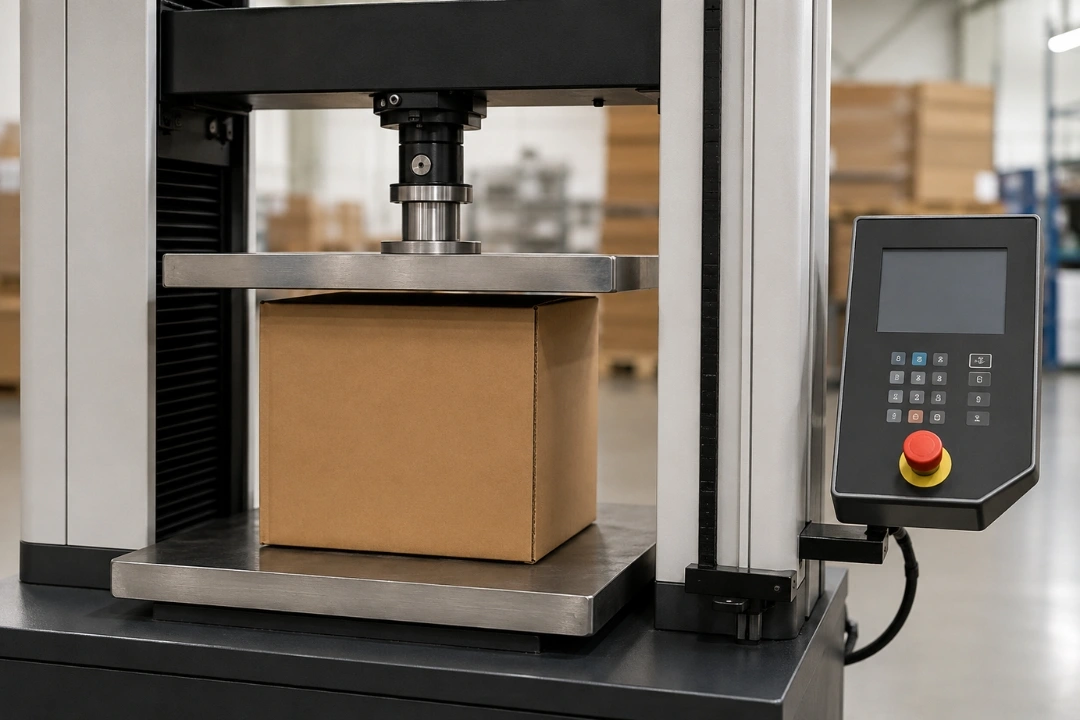
A Box Compression Test (BCT) measures how much vertical load a fully assembled corrugated box can take before it buckles. The box is placed between two flat steel plates on a compression tester, and the top plate pushes down at a fixed speed until the box collapses. The peak force recorded, usually in Newtons or kilograms-force, is the BCT value – and it’s the single number that tells a packaging buyer whether a carton can survive a warehouse stack or a shipping container without crushing whatever is inside.
If you manufacture, print, or convert corrugated packaging, this number decides more than it looks like it should. Get it wrong and you either ship damaged goods or overbuild every carton and burn margin on board you didn’t need.
Why BCT Matters More Than People Think
Picture a pallet stacked six-high in a warehouse for three weeks, then loaded into a truck, then sitting in a hot container for another ten days. The bottom box isn’t just holding its own weight – it’s holding everything above it, for the entire duration, in whatever humidity the environment throws at it.
Corrugated board is paper, and paper absorbs moisture. A board that tests fine at 50% relative humidity can lose 30-40% of its compression strength at 80% RH, and more than half at 90%. Add creep – the slow sagging that happens under any sustained load, even in dry conditions – and a box that survives five minutes on a lab platen can still fail after three weeks in storage. That gap between “passed the test” and “survived the supply chain” is why BCT exists as a formal, repeatable measurement instead of a guess.
How the Test Actually Works
The process is simpler than the physics behind it.
- Condition the sample: The box sits at standard temperature and humidity (usually 23°C, 50% RH) for at least 24 hours, so moisture content doesn’t skew the result.
- Place it on the platen: The empty box – sometimes with dividers or a dummy load, depending on the spec – sits flat between the tester’s base and its moving top plate.
- Apply the load: The top plate descends at a controlled, constant speed, typically around 12.5 mm per minute, pressing evenly across the top surface.
- Record the peak: The machine logs force continuously. The highest reading, taken right before the walls buckle outward, is the BCT value.
- Compare against spec: That number gets checked against the design requirement for product weight, stack height, and storage duration.
The whole test takes a few minutes per box, which is why converters keep a compression tester on the shop floor instead of sending samples to an outside lab every time.
The Standards Behind the Number
A BCT value only means something if it was measured the same way everywhere. That’s what standards are for:
- ASTM D642 – the most widely used North American standard for compression testing of shipping containers.
- TAPPI T804 – the pulp and paper industry’s compression test method, common in mills and board plants.
- ISO 12048 – the international standard, used when a box has to satisfy buyers across multiple regions.
None specify how strong a box must be – that’s a business call based on the product and route to market. What they specify is how the test must be run, so a reading from one lab means the same thing as a reading from another.
BCT vs. ECT vs. Mullen: Don’t Mix These Up
Buyers confuse these three constantly, and it causes real problems on the production floor.
| Test | What It Measures | Predicts | Unit |
| BCT | Whole-box compression strength | Stacking performance | N or kgf |
| ECT | Edge compression strength of the board itself | Contribution to stacking strength | kN/m |
| Mullen (Burst) | Puncture resistance under hydraulic pressure | Rough-handling durability | kPa or psi |
ECT is tested on a small strip of board, not a full box, and it’s the input most commonly used to predict BCT before a box is even built – through the McKee formula, which estimates compression strength from ECT, board thickness, and box perimeter. It’s a useful starting point for design, but it’s still an estimate. Actual BCT testing on the finished box is what confirms the design holds up, especially for non-standard box styles where the formula’s assumptions don’t apply cleanly.
Mullen tells you almost nothing about stacking strength. A box can have excellent burst resistance and still crush under a pallet load, because puncture resistance and compression resistance come from different structural properties of the board.
What Actually Changes a Box’s BCT Value
A handful of variables move the number up or down, sometimes by a lot:
- Wall construction – single, double, or triple wall board raises BCT substantially, along with material cost and weight.
- Flute profile – A, B, C, and E flutes behave differently under load; C-flute is the common choice for general shipping, B-flute for retail-ready cartons.
- Box geometry – a tall, narrow box loses strength faster than a short, wide one made from the same board.
- Liner and paper quality – higher basis weight and better fiber quality in the liners raise both ECT and BCT.
- Print and coating – heavy ink coverage or laminate can stiffen or weaken panels depending on how it’s applied.
- Environmental exposure – as covered above, humidity and time under load both erode the number the lab reported.
Where Box Construction Fits Into the Equation
BCT is a test result, but the box’s actual strength gets built long before it reaches a compression tester – on the die-cutting, folder-gluing, and lamination lines that turn flat board into a finished carton. A misaligned crease, an inconsistent glue bond, or an uneven laminate can weaken a panel in ways that don’t show up until the box is under load. Converters running high-precision equipment tend to see tighter, more predictable BCT results across a batch, instead of wide swings between boxes made to the same spec.
At Robus India, this is the layer we work in – folder gluers, die cutters, and flute laminators built for the folding carton and corrugated industries, where consistent creasing, gluing, and lamination quality directly affects how a box holds up once it’s loaded onto a pallet. A well-run production line won’t replace BCT testing, but it removes a lot of the variability that testing exists to catch.
The Bottom Line
BCT is the closest thing the packaging industry has to a stacking-strength guarantee – a controlled measurement of how much load a box can carry before it fails. It’s not the whole picture; humidity, storage time, and handling all chip away at that lab number. But paired with ECT for material-level design and validated against standards like ASTM D642, TAPPI T804, or ISO 12048, it gives packaging teams a number they can actually design around instead of guessing at.
For anyone specifying corrugated packaging, the question isn’t whether to test for BCT – it’s whether the box on the line was built consistently enough for that result to mean anything.
Frequently Asked Questions
What is a good BCT value for a shipping box?
There’s no universal number – it depends on product weight, stack height, and storage duration. A box holding light retail goods stacked two-high needs far less BCT than one holding industrial parts stacked six-high for weeks. The target is calculated from actual load conditions, then verified through testing.
Can BCT be calculated without testing a physical box?
Yes, approximately. The McKee formula estimates BCT from ECT, board caliper, and box perimeter. It’s useful for early design decisions but isn’t a substitute for testing the finished box, especially for non-standard shapes or tight margins.
Is a higher BCT always better?
Not necessarily. Overbuilding a box to hit an unnecessarily high BCT adds material cost and weight without adding value if the box will never see that load. The goal is matching BCT to actual supply chain demands, not maximizing it.