
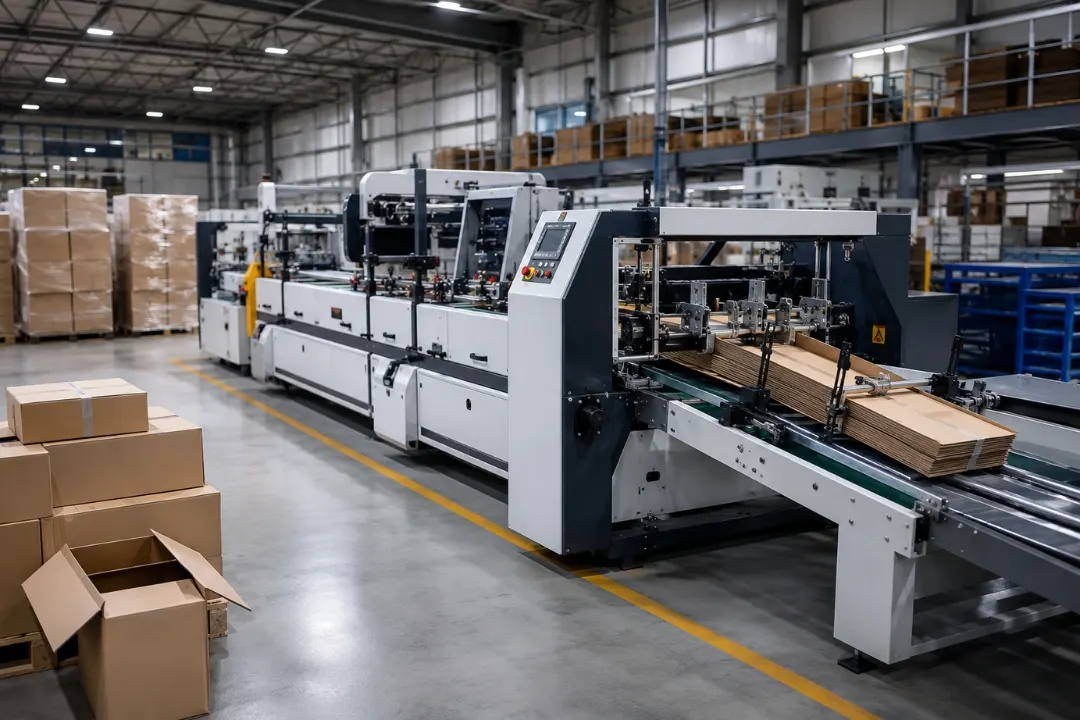
When Rohan Kaicker, Marketing Director at Cliffton Packagings, was evaluating new machinery, he wasn’t looking for a dramatic change. He was looking for something reliable and cost-effective. What he got was a 35% increase in packaging output – without touching a single wall of his factory.
“It is cheaper by around 30% and offers production capacity by more than ~35% with low wastage,” he said after installing a Robus India Automatic Folder Gluer.
For Indian packaging manufacturers who need more output but can’t afford to expand, that result is worth understanding properly.
Why Most Factories Can’t Increase Packaging Output the Way They’re Trying
The instinct is predictable: more output means more space. A bigger plant, another production line, a night shift. These options exist, but they’re expensive, slow to implement, and often unnecessary.
Most packaging lines are not running at their actual capacity. They’re running at the capacity their weakest point allows – and that weakest point is rarely the square footage. It’s usually the machine.
For folding carton and corrugated box manufacturers, the bottleneck is typically in the folder-gluer line. Manual feeding, inconsistent gluing, and slow job changeovers all cut into what the machine could theoretically produce in an eight-hour shift.
Fix those three things, and packaging output goes up – on the same floor, with the same team.
What Robus India Machines Do Differently
Robus India manufactures folder gluers, die cutters, flute laminators, and hot foil stampers for folding carton and corrugated packaging lines. Established in 2016 and based in Greater Noida, they have installed over 410 machines across India.
Here’s where their automatic folder gluers change the numbers:
Consistent Speed, Not Burst Speed
A line that hits 200 cartons per minute for 20 minutes, then stalls for a manual feeding correction, produces less than a line running 140 cartons per minute without interruption. Robus India’s automatic feeding and stacking system removes the start-stop pattern that kills effective hourly output on semi-automatic setups.
Glue Precision Reduces Rejections
Every rejected carton is a production slot that generated nothing saleable. Robus India’s gluing units apply adhesive at consistent pressure and temperature across the full run. Fewer rejects means the machine’s rated speed converts more directly into finished product – which is how you increase packaging output without running the line any faster.
Faster Changeovers Add Hidden Hours
Switching between carton sizes or box styles on an older machine can take two to four hours. On Robus India machines, that process is significantly shorter. For manufacturers handling multiple clients with different SKU requirements, reclaimed changeover time is effectively free production capacity.
The Floor Space Reality
Robus India’s automatic line consolidates what previously required multiple stations into one integrated machine. A pre-upgrade setup often looks like this:
- Manual feeding table – 1 operator
- Semi-automatic folder gluer – 1 to 2 operators
- Manual stacking and banding – 1 to 2 operators
After switching to a Robus India automatic folder gluer, most plants run the same process with one operator. The footprint shrinks. The headcount drops. The output rises.
That combination – smaller footprint, fewer people, higher throughput – is exactly how Cliffton Packagings increased packaging output by 35% without expanding their facility.
What the Numbers Look Like
Robus India machines are priced approximately 30% below comparable imported alternatives, based on Cliffton Packagings’ own evaluation. Combined with the output improvement, the payback period for most customers lands between 18 and 36 months – faster for operations that were previously turning away orders or running overtime to meet demand.
Across the packaging equipment industry, the shift from semi-automatic to fully automatic folder gluers consistently delivers 25 to 50% output gains, depending on the baseline. Robus India customers tend to land at the higher end of that range because the machines are designed around Indian production conditions – variable power supply, mixed operator skill levels, and the need for straightforward maintenance without specialized on-site engineers.
Signs Your Line Has an Output Problem, Not a Space Problem
Before committing to a facility expansion, check whether any of these apply:
- You’re running one shift but still missing delivery deadlines
- Glue rejection rates are above 2 to 3% per run
- Job changeovers regularly take longer than 90 minutes
- You’re quoting customers longer lead times than your order volume justifies
- Operators are managing three or four manual steps per carton
These are machine efficiency problems. More floor space won’t solve them.
What Customers Report After 12 Months
Jayesh Patel, MD of Kalhar Packaging, noted that the Robus India machine runs with “almost no sound and vibration.” That matters because vibration causes folding misalignment over long runs – one of the most common sources of quality inconsistency on budget machines.
Installation is also straightforward. Robus India’s team handles commissioning and operator training on-site, which reduces the risk of a new machine sitting idle while the plant figures out setup independently.
The Right Question to Ask First
Before looking at new buildings or additional shifts, the better question is: what is your current line capable of, and what is actually preventing it from running at that level?
For most folding carton and corrugated manufacturers in India, the answer is in the folder gluer. A machine that feeds automatically, glues precisely, and changes over quickly will increase packaging output on the same floor it’s already standing on.
Cliffton Packagings found that out. So did Kalhar Packaging. So have over 400 other manufacturers across India who chose Robus India.