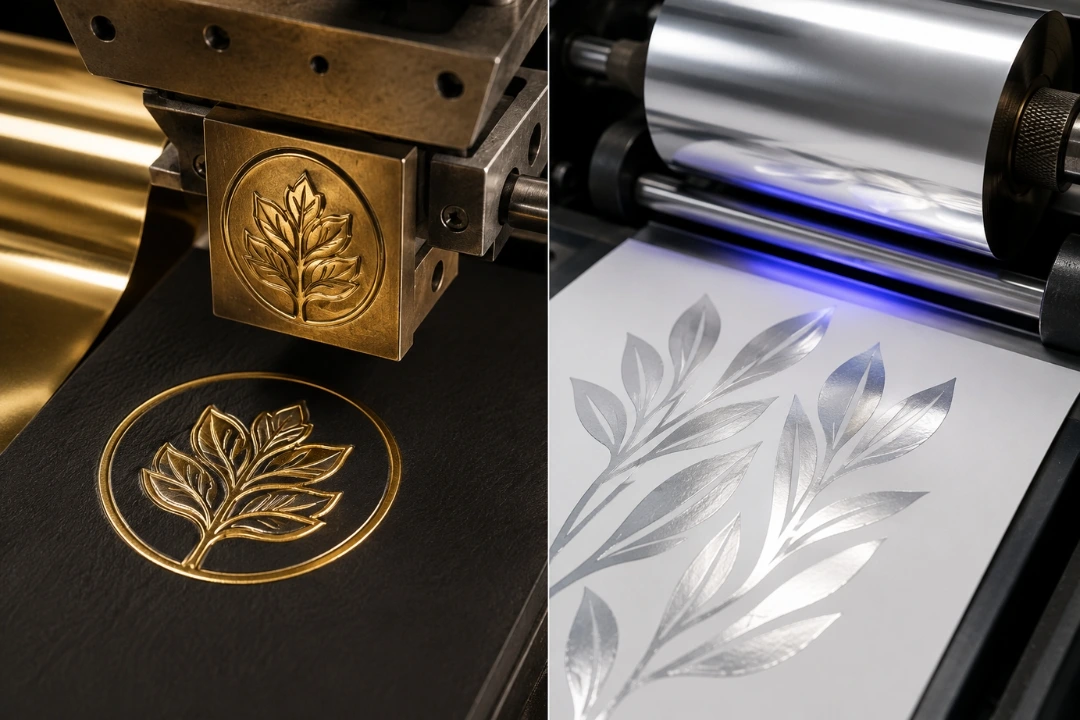
If someone just asked you to add a metallic finish to a box or label, you’ve probably run into this exact question. Hot foil stamping and cold foil stamping both put shiny, premium-looking foil on paper, board, or film. That’s where the similarity ends. The equipment, the cost structure, the run lengths, and the finish they leave behind are all different, and picking the wrong one can cost real money on a job.
Here’s the short version: hot foil stamping uses a heated metal die and pressure to press foil into the substrate. Cold foil stamping uses UV-curable adhesive and a standard printing plate, with no heat and no die. Everything else in this article explains why that one difference changes almost everything about when to use each.
What Is Hot Foil Stamping?
Hot foil stamping is the older of the two processes, and it’s still the standard for luxury cartons, cosmetics boxes, and premium retail packaging. A custom die, engraved with your design, gets heated and pressed onto the foil and the sheet at the same time. The heat melts a bonding layer on the foil, the pressure seats it into the substrate, and you’re left with a crisp, embossed-looking impression.
Because the die physically presses into the material, hot foil gives you real depth. You can combine it with embossing in a single pass, get sharp edges on fine text and logos, and produce a finish that holds up to handling, scuffing, and shipping. That’s why it’s the go-to choice for folding cartons in FMCG, pharma, and cosmetics packaging, where the box itself is part of the brand experience.
The tradeoff is setup. Every new design needs its own die, and cutting that die takes time and money. Changeover between jobs can run anywhere from half an hour to several hours depending on the machine and the complexity of the design. For a short run of a few hundred units, that setup cost gets spread thin. For a long run of tens of thousands of cartons, it barely matters.
What Is Cold Foil Stamping?
Cold foil stamping skips the die entirely. A UV-curable adhesive is printed onto the substrate using a standard offset or flexo plate, in whatever pattern the design calls for. A roll of foil is pressed onto that wet adhesive, and the assembly passes under UV light, which cures the adhesive almost instantly. The foil sticks only where the adhesive was applied, and the rest peels away.
Because it runs inline on a printing press, cold foil doesn’t need a separate machine pass. Ink, foil, and varnish can all go down in the same run, which is a real advantage when you’re printing thousands of labels or cartons back to back. Changeovers are also faster since there’s no die to swap, just a plate change like any other print job.
The catch is durability and substrate range. Since the foil sits on top of the adhesive rather than being pressed into the material, it’s more prone to scuffing on rough handling, and it doesn’t perform as well on uncoated or highly absorbent stocks, which soak up the adhesive unevenly and leave patchy foil coverage. Cold foil also can’t replicate the embossed, tactile depth that a hot foil die gives you.
Hot Foil vs Cold Foil: Side-by-Side Comparison
| Factor | Hot Foil Stamping | Cold Foil Stamping |
| Process | Heated die + pressure | UV adhesive + standard plate |
| Tooling needed | Custom die per design | No die, standard plate |
| Best for | Short to long runs, premium finish | Very large, high-speed runs |
| Setup/changeover time | 30 minutes to several hours | Minutes, plate change only |
| Substrate range | Works well across most stocks | Struggles with uncoated, absorbent stocks |
| Embossing/depth | Yes, in the same pass | No, flat finish |
| Durability | High, foil is pressed into the material | Moderate, foil sits on the surface |
| Multiple foil colors | Separate die/pass per color | Can vary by section in one pass |
| Typical use case | Folding cartons, rigid boxes, luxury retail packaging | High-volume labels, some flexible packaging |
So Which One Should You Actually Use?
It comes down to three questions: how many units are you running, what’s the substrate, and how much depth do you need in the finish.
If you’re producing folding cartons or rigid boxes for cosmetics, pharma, or premium FMCG brands, hot foil stamping is almost always the better call. Brand owners in these categories want that embossed, high-shine look on the shelf, and the durability matters when cartons go through transport and handling before they ever reach a customer. The die cost is a one-time investment that pays off across the production run, and for a repeat order, the die is already made.
If you’re running high volumes of labels where the design changes often, or you need inline efficiency because you’re already printing ink and varnish in the same pass, cold foil earns its place. It’s harder to justify for one-off luxury cartons, but it makes sense for beverage labels, promotional packaging, or anything printed at speed where a flat metallic shine is good enough.
A lot of converters actually run both, choosing per job rather than committing to one technology across the board.
Where Robus India Fits In
Robus India builds automatic hot foil stamping machines for the folding carton and corrugated packaging industry, including the Excellence, Performance, and Confidence series. These machines use heated engraved dies to apply foil with the pressure and precision that premium packaging brands expect, and they’re built for the FMCG, cosmetics, pharmaceutical, and electronics packaging segments where a durable, high-end finish is non-negotiable.
If your production line is weighing hot foil against cold foil and you’ve landed on hot foil for durability or shelf appeal reasons, it’s worth looking at what a dedicated automatic hot foil stamper can do for your changeover times and output consistency compared to older equipment.
Frequently Asked Questions
Is hot foil stamping more expensive than cold foil?
Per unit, hot foil usually costs more on short runs because of die-making, but it evens out or beats cold foil on long runs since there’s no per-unit adhesive and plate cost stacking up the way die amortization does.
Can cold foil be embossed?
Not on its own. Cold foil lays flat since there’s no heated die pressing into the substrate. Some converters combine cold foil with a separate embossing step, but that adds a pass and cost.
Which method works better on uncoated board?
Hot foil. Uncoated, absorbent stocks tend to soak up the UV adhesive unevenly in cold foil, which leads to patchy coverage. Hot foil’s heat-and-pressure method is more forgiving across substrate types.
Do I need different foil rolls for hot and cold foil machines?
Yes. Hot foil uses a heat-activated release layer, while cold foil is designed to bond with UV-curable adhesive. They’re not interchangeable between machines.
Is one method better for the environment?
Cold foil uses less energy since there’s no heating element, but hot foil wastes less material on long runs. Neither has a clear edge; it depends on run length.