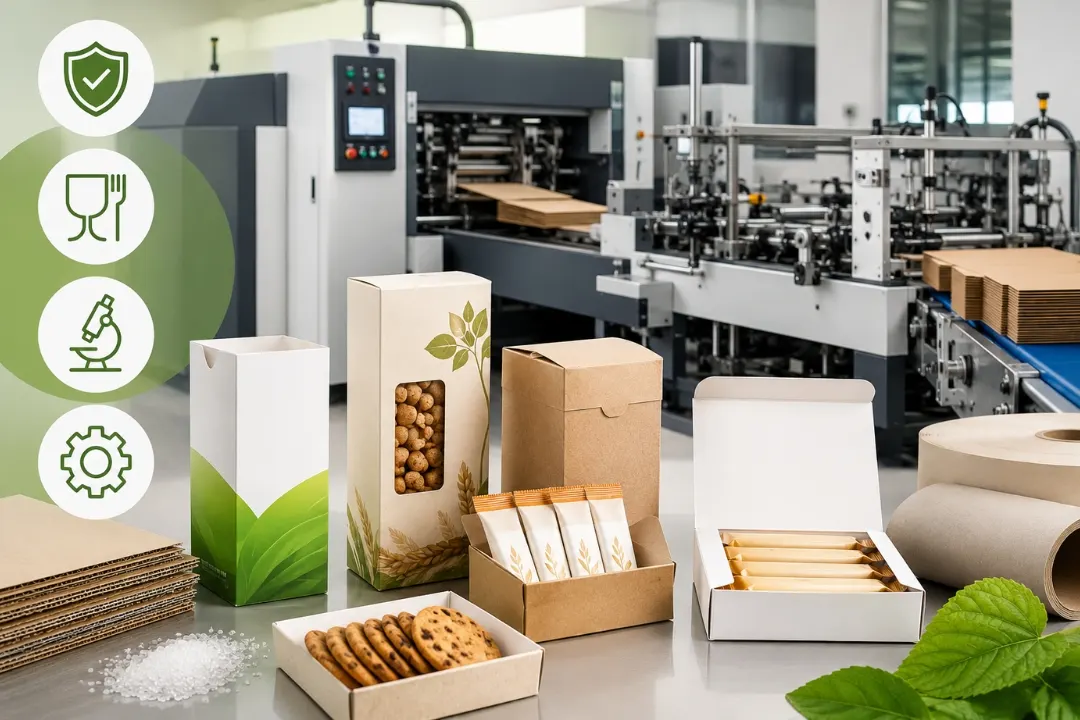
Walk into any supermarket in India and pick up a box of biscuits, a cereal pack, or a tea carton. What you’re holding is a food-grade carton – and getting it right involves a lot more than printing a logo on cardboard.
For Indian FMCG brands, this is where things get serious. FSSAI tightened its grip on packaging compliance in 2025, reclassifying food-grade packaging materials from “non-critical” to “critical” during inspections. That single regulatory shift changed how packaging lines need to be set up, what documentation brands must maintain, and what machines they actually need on the floor.
This article breaks down the full picture: the standards you must meet, the machines that get you there, and where most brands quietly get it wrong.
What Makes a Carton “Food-Grade”?
A carton qualifies as food-grade when the materials used – paperboard, adhesives, inks, coatings, and laminates – do not transfer harmful substances into the food product they contain.
Under the Food Safety and Standards (Packaging) Regulations, 2018, all food contact materials in India must comply with Bureau of Indian Standards (BIS) specifications listed in the regulation’s schedules. For paper and paperboard, this means the raw substrate must be free from contaminants and meet the IS standards cited in Schedule I of the regulations.
There are two categories worth understanding:
Primary packaging: the carton surface in direct contact with food. Think of the inner lining of a cereal box or the base of a sugar sachet tray. Any coating, film, or adhesive here must be food-safe and tested accordingly.
Secondary packaging: the outer carton that holds primary packs. These still need to meet general material standards but have slightly more flexibility.
Where brands trip up: using standard commercial-grade boards sourced from regular paper mills without verifying IS compliance, then discovering the gap only during an FSSAI inspection.
The Regulatory Checklist Indian FMCG Brands Must Clear
FSSAI (Packaging) Regulations, 2018: This is the primary law. It replaced the 2011 packaging and labelling regulations and covers migration limits, approved substances, and BIS references for each material type. The regulation sets an overall migration limit of 60 mg/kg or 10 mg/dm² for packaging materials.
NABL-Accredited Certification: Since April 2025, FSSAI inspectors now check whether packaging materials carry a Certificate of Conformity issued by a NABL-accredited laboratory. This isn’t optional. Brands need to maintain these records at the facility and have them available during audits.
BIS Standards for Paperboard: Boards used in food cartons must conform to IS specifications under Schedule I. The specific IS numbers vary by material type – your board supplier should be able to confirm which standard applies to their product.
Food-Grade Inks and Adhesives: Printing must not appear on the inner surface that contacts food. The inks used on outer surfaces must also be approved food-grade formulations. Similarly, the adhesive used in folder gluers must be food-safe – a detail that gets overlooked more often than it should.
Tamper Evidence: For certain categories like spices and milk powder, FSSAI requires tamper-evident closures. The gluing and folding quality of the carton directly affects whether this requirement is genuinely met or just nominally satisfied.
The Machines Behind a Compliant Food Carton Production Line
Sourcing food-grade board is step one. Converting that board into finished, inspected, shelf-ready cartons at volume is the harder part – and it’s where the right machines make the difference.
Automatic Die Cutter
This is where flat sheets are cut and creased into the exact blank shape the finished carton will take. For food packaging, precision here is non-negotiable. A misaligned crease line means corners that don’t fold cleanly – and poorly sealed carton corners are a direct contamination risk for dry food products. High-speed automatic die cutters maintain cut-to-crease accuracy across long production runs, which is where most semi-automatic machines struggle.
Automatic Folder Gluer
After die cutting, blanks move to the folder gluer, where they’re folded into box shape and sealed with adhesive. For food-grade production, two things matter here beyond speed: the glue must be food-safe and applied consistently, and the machine must handle the board without contaminating it through oil, debris, or excessive mechanical contact. Modern servo-driven folder gluers handle this far better than older belt-driven systems.
Brands producing mono cartons for cereals, biscuits, confectionery, and dry snacks will spend most of their machine budget here – and should.
Automatic Flute Laminator
For heavier FMCG cartons – the kind used for multi-pack products, larger grocery items, or anything that needs to survive retail shelf stacking – flute lamination adds a corrugated layer to the base sheet, increasing crush resistance and rigidity. The lamination adhesive used in food-adjacent applications needs to be specified carefully with your machine supplier.
Inspection Systems (Inline)
This is where a lot of smaller brands cut corners and later pay for it. Inline vision inspection systems – often available as integrated modules on folder gluers – check for print registration errors, missing perforations, incorrect glue patterns, and blank orientation issues. For food brands running high-volume lines, catching a bad batch before it reaches the warehouse is far cheaper than a recall.
Common Mistakes That Cause Compliance Failures
Buying machines without checking glue compatibility: Folder gluers come set up for standard cold glue. If your application needs food-safe hot melt adhesive, this has to be specified at the time of purchase – retrofitting is expensive.
Skipping the NABL test on board procurement: Many converters source board without confirming the supplier’s IS compliance documentation. In the post-2025 inspection environment, this is audit exposure.
Treating secondary packaging as out-of-scope: Even cartons that don’t touch food directly can fail inspection if the materials don’t meet FSSAI general requirements.
Ignoring ink migration on printed surfaces: Solvents from UV or solvent-based inks can migrate through paperboard into food. Using approved food-grade inks is a regulatory requirement, not just a best practice.
Getting the Production Setup Right
For Indian FMCG brands scaling up packaging capacity, the decision isn’t just about machine speed – it’s about building a line that passes audits and holds up over time.
That means starting with material compliance (board, ink, adhesive), selecting machines that handle food-adjacent applications correctly, building in inspection, and maintaining the documentation FSSAI now requires at every stage.
Robus India manufactures the full range of carton packaging machines – from automatic die cutters and folder gluers to flute laminators and film lamination systems – with installation and after-sales service across India. Whether you’re setting up a new food packaging line or upgrading existing equipment to meet current FSSAI standards, the machine configuration needs to fit the compliance requirements, not just the production targets.
Getting both right at the same time is entirely possible. Most brands that struggle with food packaging compliance were never shown how the two connect.