Every packaging unit reaches a point where the question isn’t “what’s wrong with the machine this time” but “why does this keep happening?” A technician comes, fixes the immediate fault, and a few weeks later you’re back to square one. At some stage, repeated servicing stops being maintenance and starts being a workaround for a machine that’s simply outgrown your production needs.
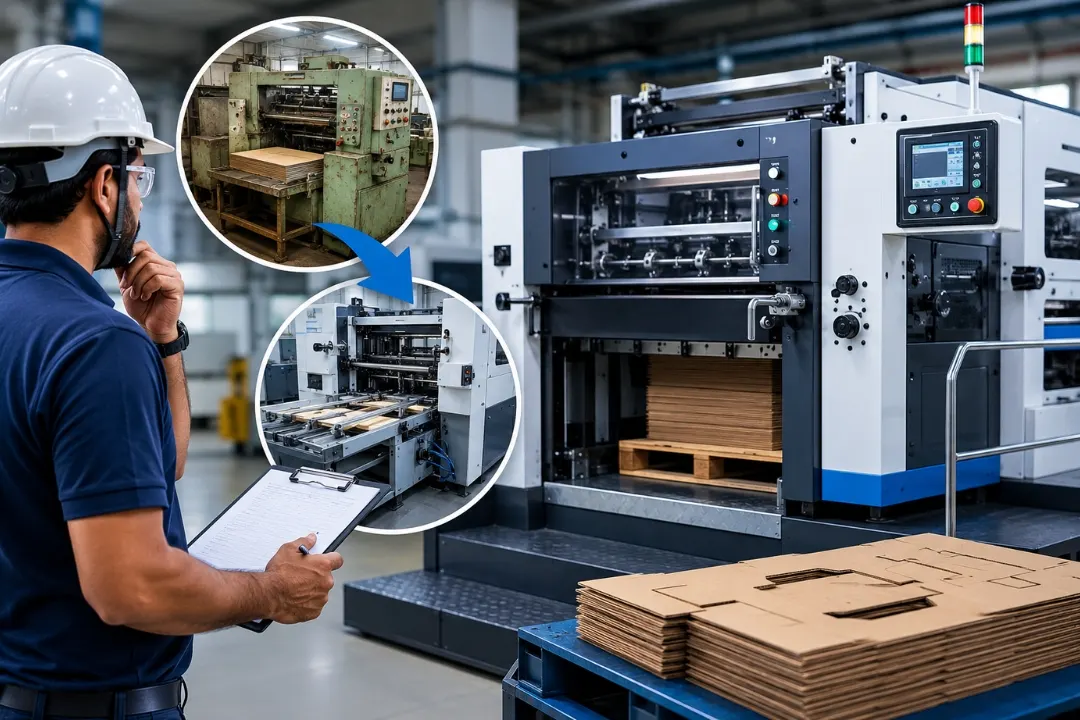
A die cutting machine upgrade doesn’t always mean buying a brand-new unit on day one. Sometimes it means moving from a manual feeding setup to an automatic bottom feeder, adding a stripping station, or replacing an aging press with a model that matches your current order volumes.
The hard part is knowing when you’ve crossed that line. Here are five signs that point to an upgrade rather than another service call.
1. The Same Faults Keep Coming Back After Every Service
If your maintenance team has visited three or four times in the last few months for the same issue – misaligned cuts, pressure drops, or feeder jams – the problem usually isn’t the part that was replaced last time. It’s the underlying system that part belongs to.
Older die cutters were built around mechanical drives and manual adjustments that drift out of calibration faster as components age. A service visit resets the symptom, not the cause. When you start tracking your maintenance log and notice the same fault recurring every 6-8 weeks, that’s the machine telling you it’s reached the end of what servicing can fix.
2. Production Speed Can’t Keep Up With Order Volume
This is the most common reason packaging units in India quietly start looking for an upgrade. Your order book has grown, but your die cutter’s output hasn’t. Maybe it was sized for 4,000-5,000 sheets per hour five years ago, and that was fine then.
Today, with bigger clients and tighter deadlines, that same speed means overtime shifts, missed delivery windows, and jobs getting subcontracted out because your own floor can’t absorb them.
A servicing technician can keep an old machine running at its original speed, but they can’t make it run faster than its design allows. If you’re regularly running extra shifts just to hit the numbers a newer automatic die cutter would handle in one shift, the math on an upgrade starts to look very different.
3. Cut Quality Is Inconsistent, Even Right After Maintenance
Here’s a pattern worth watching for: the machine gets serviced, runs perfectly for a day or two, and then registration starts drifting again – cuts that don’t line up with the print, slightly ragged edges, or creases that crack instead of folding cleanly.
If this happens even with sharp dies and correct pressure settings, the issue is often in the machine’s frame rigidity, feeding accuracy, or control system, not in any single replaceable part.
For folding carton and corrugated converters, this is where customer complaints start. A buyer doesn’t care that your machine is “mostly fine” – they care that this batch doesn’t match the last one.
When cut quality becomes a coin toss despite proper upkeep, an upgrade to a machine with better registration control and a sturdier build usually resolves it for good, rather than chasing it batch by batch.
4. You’re Still Running Manual Feeding, Stacking, or Counting
Manual feeding and offloading worked fine when output requirements were lower and labour was easier to plan around. But as volumes grow, these manual steps become the actual bottleneck – not the cutting itself. An operator feeding sheets by hand can only move as fast as a person can move, and that caps everything downstream.
If your current setup still relies on manual feeding tables, hand-stacking after cutting, or separate counting before dispatch, that’s a strong signal you’re due for an automatic die cutter with an integrated feeder, collecting table, and carton counter.
These additions don’t just speed things up – they cut down on the inconsistency that comes from manual handling, and they free up operators for tasks that actually need a person.
5. The Machine Can’t Handle Newer Job Types Your Clients Are Asking For
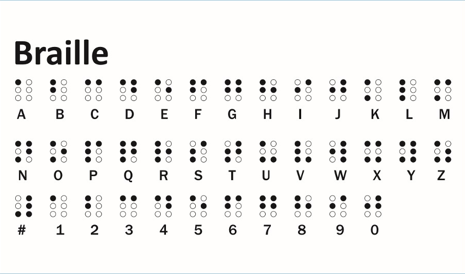
Packaging requirements have shifted quite a bit in the last few years – rigid boxes, Braille embossing for pharma cartons, intricate die-shapes for e-commerce packaging, and tighter tolerances across the board.
If you’re turning down jobs, or quoting them at a loss because your current die cutter struggles with certain board thicknesses, intricate shapes, or specialised finishes like hot foil and lamination, that’s not a servicing problem at all.
A machine that was built for standard folding cartons a decade ago was never designed for some of today’s specifications, no matter how well it’s maintained. In this case, the question isn’t “can this be fixed” – it’s “can this machine ever do what my clients are now asking for.” Usually, the honest answer is no, and that’s when looking at a different series or model class makes more sense than another repair.
Servicing vs Upgrading: How to Decide
Servicing makes sense when a fault is isolated, the part is genuinely worn out, and the rest of the machine is still performing within its original specs. Upgrading makes sense when the faults are recurring, the bottleneck is structural (speed, feeding, or capability), or your business has simply moved past what the machine was built for.
A useful way to check: add up what you’ve spent on service visits and downtime over the last 12 months, and compare that against the production gains an upgraded machine would bring – faster cycle times, fewer rejects, less manual labour. For a lot of converters, that comparison alone settles the decision.
Where Robus India Fits In
Robus India has been manufacturing carton packaging machinery from its Greater Noida facility since 2016, with automatic and semi-automatic die cutters across the Excellence, Performance, and Confidence series, along with bottom feeder die cutters, folder gluers, and flute laminators for folding carton and corrugated converters. If any of the five signs above sound familiar, it’s worth getting an assessment of your current setup rather than scheduling yet another service visit.
Our team can walk through your production data, current machine specs, and the job types you’re being asked to handle, then suggest whether a targeted upgrade or a new die cutting line makes more sense for where your business is headed. Get in touch with Robus India to discuss your requirements.