E-Commerce Returns & Damaged Boxes: How Corrugated Box Making Machines Reduce Loss
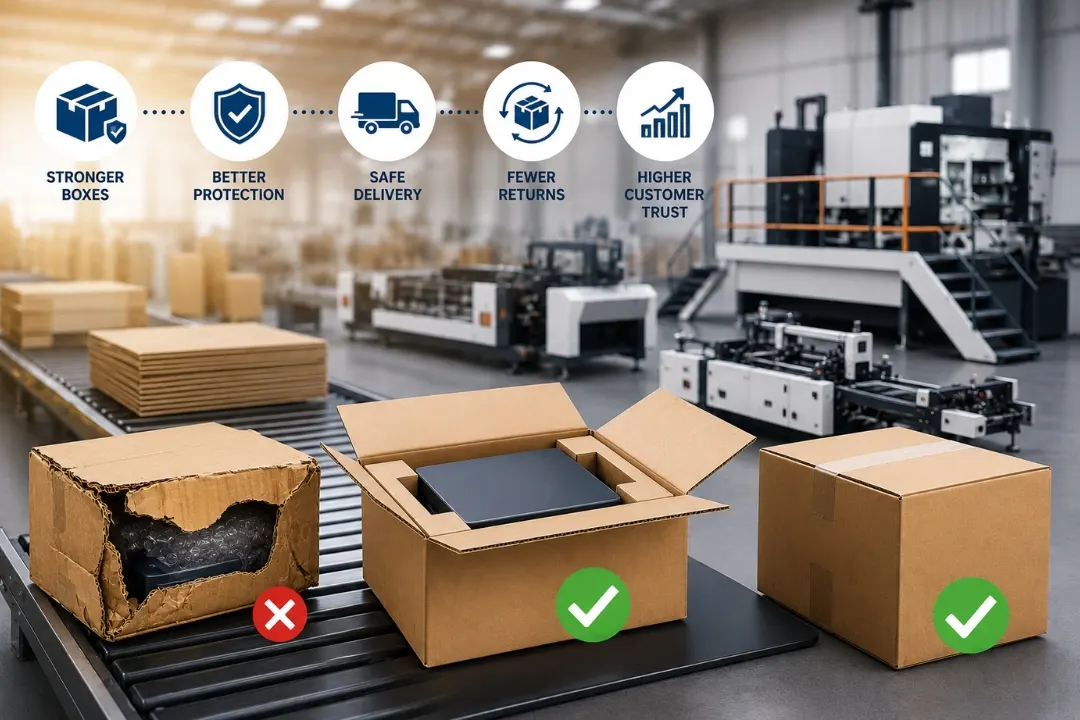
Nobody talks about how expensive a return actually is. You sell a product for ₹800. The customer gets it with a dented corner, a cracked lid, or a shattered screen. They raise a return request. You spend another ₹150–₹400 on reverse logistics, restocking, re-inspection, and re-dispatch. In some cases, the product can’t even be resold. That ₹800 sale just turned into a net loss. This is the reality of e-commerce returns in India and globally, and it happens every day – at scale. What’s wild is that most of this is preventable. Not through better policies or faster customer support, but through better boxes. The Numbers Behind E-Commerce Returns Are Hard to Ignore Global merchandise returns crossed $890 billion in 2024. The e-commerce return rate was 16.9% last year and is expected to hit 19.3% in 2025. In India, return rates on platforms like Meesho and Flipkart routinely run between 20% and 40% depending on the category. The bigger problem inside these numbers: 80.2% of returns happen because the product arrived damaged. Not the wrong size. Not changed mind. Damaged. And here’s the part that should bother anyone running an e-commerce or packaging business – 51% of customers who receive a damaged shipment don’t buy from that brand again. They don’t complain loudly, they just leave. That’s the damage you don’t see on a returns dashboard. Why Boxes Actually Fail in Transit A corrugated box failure during shipping is rarely random. There are a handful of reasons it keeps happening, and they’re all fixable. The box is the wrong size: When a box is too big for the product inside, the product moves. It shifts, bounces, collides with itself or the sides. That movement causes damage – especially for anything fragile, electronic, or with sharp edges. Undersized boxes have the opposite problem: the flutes get crushed under external pressure, and the structural integrity collapses. The board strength doesn’t match the product weight: A single-wall corrugated board works fine for a 500g item. Use the same board for a 5kg appliance, and it won’t survive three handling points. The edge crush test (ECT) rating needs to match the actual load – and it often doesn’t when brands order generic stock boxes. Glue joints and folds are inconsistent: In high-volume manual or semi-manual operations, box assembly quality varies. A weak glue line or an uneven fold means the box opens at a seam under pressure. It doesn’t take much – one drop, one compression on a conveyor – and the product is exposed. Each of these failure points happens before the courier ever picks up the shipment. They’re baked into the packaging at production time. That’s where the fix needs to happen too. What Better Machines Actually Change The connection between machine quality and e-commerce return rates is direct, even if it’s not talked about enough. Folder Gluer Machines The folder gluer is what assembles the flat sheet into a finished box. When a folder gluer is running precisely – consistent glue pressure, accurate folding alignment, correct speed calibration – the boxes it produces are structurally sound every single time. The seams hold. The corners are clean. When the machine is old, poorly calibrated, or running too fast for the board type, defects get baked in. Not every box fails, but enough do that the return rate climbs. Robus India’s Automatic Folder Gluer Machines – built in three series: Excellence, Performance, and Confidence – are designed for corrugated carton production with high-precision folding and consistent glue application. For e-commerce brands dealing with high SKU volumes, this kind of consistency matters more than most realise. Die Cutting Machines Die cutting is what gives each box its exact dimensions. A precise die cut means the box folds cleanly, closes tightly, and fits the product with minimal void space. Void space is underrated as a damage source. Every centimetre of space inside a box is room for the product to move. Custom die-cut boxes – sized specifically for a product’s actual dimensions – remove that space. Products arrive the way they were packed. Robus India’s Automatic and Semi-Automatic Die Cutting Machines handle a range of corrugated sheet sizes, which makes it practical to produce custom box profiles for different SKUs without massive setup overhead. Flute Laminator Machines For heavier products – electronics, kitchenware, large D2C shipments – single-wall board just isn’t enough. 3-ply and 5-ply corrugated board absorbs significantly more impact and resists compression under warehouse stacking loads. Robus India’s High Speed 3-Ply and 5-Ply Flute Laminator (Model: RI-3LF-1450HS) produces multi-wall corrugated board at production speed. For any brand that’s repeatedly seeing damage on heavier items, switching to a higher-ply board is often the fastest fix. Right-Sizing Is Where Most of the Gains Come From There’s a concept in packaging called right-sizing – it just means making a box that fits the product. Obvious in theory, rarely done well in practice. Most Indian e-commerce sellers work with 8–12 standard box sizes and try to fit hundreds of SKUs into those. It works well enough until it doesn’t – until a customer posts a photo of their product rattling inside a box three times too large, or arrives with half the corner caved in. Right-sized boxes cut internal product movement to nearly zero. They also reduce DIM weight shipping costs, which for high-volume sellers can be a significant monthly saving. And they use less material per box, so the cost per unit drops. Getting there requires a machine setup that supports custom sizing – automated die cutting and folder gluing that can shift between box dimensions quickly. Robus India’s E-Commerce & Q-Commerce Box Making Machine was built specifically for this: fast format changes, high output, and accurate dimensions across a wide range of box sizes. Packaging Is Part of the Brand, Whether You Think About It or Not There’s a reason unboxing videos exist. Customers notice packaging. A box that arrives clean, intact, and well-formed tells them something … Read more